Practice
________
Lectures / Workshops
Placemaking / Gatherings
Land Conservation
Visual Arts
/ The Factory
/ The Gentlemen House
/ The Greenhouse
Academic
__________

How can I, as a designer and researcher, design reformed mental models and methods for a Regenerative design learning module that closes the gap between human and non-human species?
It may be dark here
but I am not alone
In this creative writing article, Mother Earth is cast as the protagonist and narrator who explores her multiple identities and voices her agencies and concerns in this era of climate emergencies.
INTRODUCTION
It is being spoken and preached in abundance, with grief and worries occupying the commotion. It is a narrative of disruption; a weary message told through veering winds, harsh rising seas and drastically alternating landscapes. A message of massive change that intensely adjusts the fragile balance of my natural, interconnected and versatile habitant. I am on the verge of despair and deep concern.
I am not only part of the scenery but also the most vital mix of components and multiple identities that make up our only home. The magnitude of how it has become disarray mixed with wicked problems is profoundly laborious to measure. This telling echoes in the muffled weeping of premature blossom that previously harmonised with the seasonal melody. Now it is challenged and faced by erratic patterns accompanied by the accelerating warming as the feverish symptom of uncontainable careless acts on my delicate health. My withering lungs of assuring trees, ancient and new, struggle to sustain life. I am transformed into witnesses and victims, watching helplessly as fire and looting diminish my presence and simultaneously minimising the diverse ensemble of biodiversity that is part of me.
"The well-being and flourishing of human and nonhuman Life on Earth have value in themselves. These values are independent of the usefulness of the non-human world for human purposes"
arne næss & george sessions

Emerging at the threshold of ground where curious fungi meet daylight
Lives are being threatened including those of the nonhuman* as it slowly empties in sight. It is together with the nonhuman that ‘of diversity and of symbiosis’ (Næss 2005) complete our living and deep ecological systems. I sigh with the same shifting winds, carrying tales of extreme recurring weather happenings, of hurricanes, droughts, and floods. These are my laments, my desperate cry for attention, my plea for the consequences of its actions to be recognised. The notion of llearning to unlearn the menacing behaviours that currently intimidate humanity’s existence is crucial. The same veering wind steers high to cast its sharp warnings for such minds so hubris and nearly blind that will be outlived by remorse and regrets. Let the same veering wind shift how these minds should know and learn how the roles of symbiotic empathy can revolt and bring calm again to our home.
“Life creates conditions conducive to life”
janine benyus
Winter recess; the annual spell where I slumber to recuperate and harness new vigour for the warmer seasons to come. As I temporarily lie dormant in almost all senses, my premises are muted. The surrounding hues are tarnished and its touch is simply frigid.
EARTH AS A MATERIAL SUBSTANCE
Underneath the earth, I am soaked in the moist, placid and jet-black humus. It may be dark here but I am not alone. I rest with the network of sprawling rhizomes, the lattice of mycelium that mingle with the lengthy gliding earthworms in the slowest steady rhythm. I am punctured with cavities allowing the next rain to penetrate the compact forts. In this recess, every activity is unhurried and tranquil. Within this rich context, I am surrounded by essential elements accommodating multiple abilities. Underneath the earth, I am resources and materials capable of regenerating multifaceted characteristics and functionalities time and time again. I am also different minerals spanning from sands, clay, rocks, water, gases and other organic matter and ‘such materials furnish necessary physical foundations for life’ (Ingold 2007). Hence for centuries, I have been the fabricator to realise ideas and dreams, from primitive shelters, and majestic cathedrals to a modest ceramic cup.
Underneath the earth, every single organism is part of a huge spectrum of interconnectedness and relations. “Soil is the source of all life on earth, and without it, humans cannot survive” (Oosterheerd et al 2021). However, “humans show scant regard for this vital part of the living environment” (Oosterheerd et al 2021). I am being depleted as the minute ticks. Excess robbing of my essential parts is encouraging my deterioration. The extraction is severe and immersed allowing me inadequate time to regenerate new lives. Emptied lifeless quarries and drained shrivelled lakes are the harrowing scars and the new Anthropocene landscape. With my parts burrowed out, I am a limbless mother weakened, the act of life unravelling as the essence of my being is withdrawn. Hollowed and weary, I yearn for the healing touch of mindful stewardship to mend the wounds and revive the vitality that once defined me.

EARTH AS THE ONLY HABITABLE PLACE FOR ALL SPECIES
Above the earth, as I pry my miniature eyes out of a loose mount of dirt akin to the likes of a humble mole, I enter the breakpoint where soil meets the ground. From my low and meagre perspective, the earth that inhabits all species is vast and powerful. While daylight baths with warmth and optimism; it nourishes us with the ultimate language of sustenance and existence. I may not have the prestigious sight to witness all the copious fruits of life above ground but life itself resonates a distinct presence even in the deep winter. Snagged in thick layers of woollen fleece, I can keep warmth from tip to toe. As I peek away, I stare at the nuance of how a pair of feet is meticulously protected and covered by hides of different shades.
Scattered about almost miraculously, I also provide mouths with food to eat. From the parade of ruby leaves to amber crops of various sizes, I bear nourishment and fortune to satisfy hunger and survival needs. However, with the lingering fever sweating above the earth, crops will fail, and water, once the nourishing essence of flourishing fields, becomes an absent healer. “Drought might be an even bigger problem than heat” while my “most arable land turning quickly to desert” (Wallace-Wells 2017). The relentless impact of climate-inflicted weather casts a shadow upon the fields, as the soil, cracked and sterile, bears witness to the repercussions of ecological imbalance. In the face of this ecological challenge, an urgent request is obvious, urging humanity to undergo a collective mind shift, embracing empathic practices and harmonious coexistence to restore the delicate balance between nature's rhythm and secure the sustenance of future generations.
EARTH AS THE CATALYST FOR CHANGE
Despite all I can unconditionally give, I find myself distressingly deprived. In this union of earth opulence, the prospect is hindered by abyssal shades of fear and bleak darkness. But I remind myself again, it may be dark here but I am not alone. The interconnectedness of how we bridge is the urgent motivation for new beginnings and flourishment. I am timid to feel my weakening fate but I see potential* and stimulus for adjustments to reach “ecological harmony or equilibrium” (Næss 2005) while reinstating our Earth’s “inherent value” (Næss & Sessions 1984). As a catalyst for regenerative change, I implore humanity to recognize the symbiotic partnership we share, fostering a harmonious connection that not only rejuvenates my ailing vitality but also sparks a renewal in the collective spirit, propelling us towards a sustainable and regenerative future.
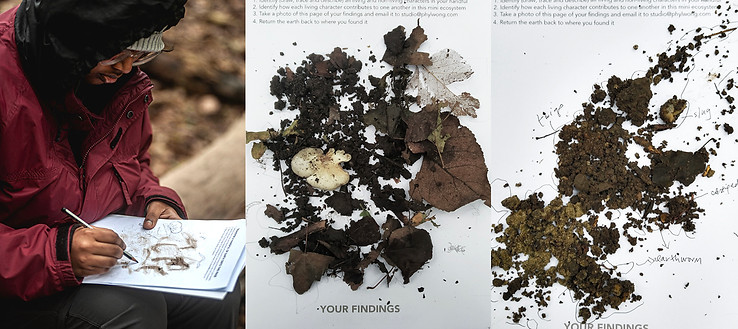
As I can be effortlessly gathered in a handful for examination and discourse, take me as a force of change and transformation. With the curious tools, use me as a medium, role model or source of hope. Inspect me thoroughly as this simple yet profound act served as an opportunity to observe the intricate dance of reciprocity among the organisms within. It is a call to recognise the symbiotic relationships that form the foundation of the natural world. Embedded in this observation is a deeper message, a call for a fundamental paradigm shift* that is essential to learn “to move humanity towards a more responsible and sustainable way of participating in natural processes” (Wahl 2005). “The role of human beings on Earth needs to shift. We must transform from despoilers to co-evolvers.” (Mang & Haggard et al 2016). I prompt humanity to depart beyond exploitation and adopt a mindset of reciprocity and respect for the environment. The handful of earth is the witness to give-and-take, the cycles of nourishment and renewal that sustain life. It is a symbol of the interconnectedness of all members in this living system, emphasising the need for harmonious coexistence. It is an invitation to re-evaluate and change the relationship with me and to cultivate a sustainable and regenerative approach that honours the delicate balance of the ecosystem for the well-being of both our home and its inhabitants.


ITERATION RECIPROCITY
The outing took place on a grey cold autumn day and lasted a couple of hours. The participants were a youthful group of composed, curious and creative young adults. They were thrilled with the idea of a field trip to begin with. Armed with their slick waterproof gears, thick-soled shoes, polished cameras and handy pocket knives, they diligently followed instructions to look first for an ‘earth item’ which spoke out to them. After carefully surveying the thick and calm woods, they strolled back with a colourful collection of acorns, stones and leaves. With the item held in their palm, we took some moments to gather and sat in a ring. As we paused, we gently entered a mental imaging exercise of revisiting an act of reciprocal in our memory. The woods remain silent and still. The peculiar birds chipping came and left. Wilted leaves rustled to the late autumn breeze, slightly lifting off the moist ground and resting again.
As we picked up the present moment again, we separated to gather a handful of earth, just so delicately off the raw surface either under a weathered log or the densely-weaved moss. There was not much talking involved and our surroundings remained noiseless. They were in full focus on a simple and childish play. All eyes were surveying the dark humus while carefully separating the composition with the tips of their knives. The content was very dense, moist and in clotted pieces. Awaken without a doubt were the half-hibernating worms, some longer than our fingers, struggling to the sudden daylight and fighting in slow dance for refuge. There were shells, extremely small shells and still intact. Laces of fragile root fragments were spotted along with tiny fungi of various types while the rotting leaves in the small pile had transformed into intricate sheets of translucent artwork.
I found a patch of flattened spot adjacent to a low-lying tree trunk and sat down. The students were dispersed within about 50 meters away from me, some standing, some squatting, some on their knees. They were all still playing Sherlock Holmes while unravelling about the dead and alive on their handful. I continue to watch as they let their inquisitiveness lead the way. In my mind, I replay the words ‘if plants are our oldest teachers, why not let them teach?” (Kimmerer 2013)

NO CONCLUSION
After winter recess, a new season will soon begin. With the benefit of stretched idle time, Mother Earth will harness the opportunity to pause and plan for new growth again. It is a loop repeating with no end and no conclusion. In her mind, her act of giving and providing is continuous, naturally also without an end. With the recurring cycles of regeneration, Mother Earth orchestrates another ceaseless symphony of life. In the quiet of bleak, still winter, she inspects the renewed paradigm for spring’s coming. Time stands witness to her unfailing commitment, as every seed planted holds the promise of a possible thriving future. Her generosity is abundant, surpassing any human understanding and her charity is the resilience woven into the complex structure of nature. Within the delicate and elaborate patterns of seasons, she, the protagonist, preaches the fundamental lesson of rebirth; a profound reminder that her act of giving is not merely a temporary gesture but an everlasting narrative woven into the very essence of our shared existence.
***** *****